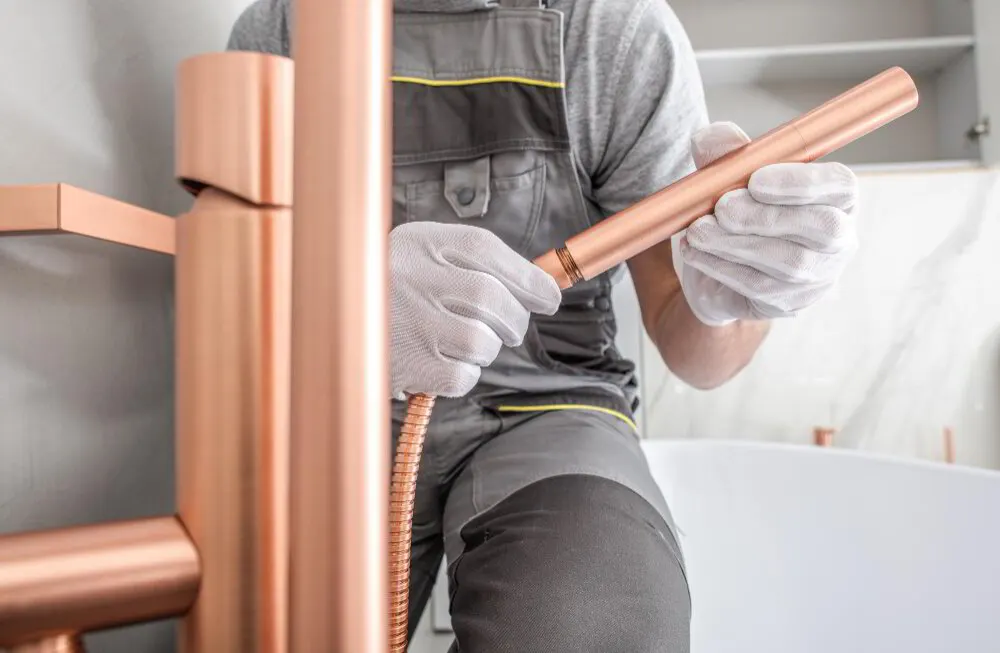
Choosing and Installing Quality Copper Piping in Hudson Homes
Hudson combines a historic village center with Western Reserve character and wide neighborhoods of larger homes built in more recent decades. Homeowners here tend to care about how work is done, not just whether it gets done. If you are planning new copper or replacing old lines, the choices you make on pipe and fittings affect how long the system lasts. K & K Plumbing installs and repairs copper in Hudson, about 32 miles north of our East Canton shop.
Picking the Right Wall Thickness
Copper water pipe comes in three common weights, identified by a colored stripe printed along the pipe. The difference is wall thickness, and it matters for durability.
Type M (red stripe)
The thinnest wall. It was widely used inside homes because it costs less and is fine under many conditions. With aggressive water or high velocity, though, it has less metal to lose before a pinhole forms.
Type L (blue stripe)
A heavier wall that gives more margin against erosion and corrosion. It is our usual recommendation for interior supply lines, especially hot water, in homes where the owner plans to stay for the long haul.
Type K (green stripe)
The heaviest wall, used mainly for buried water service lines between the street or well and the house.
Soldered Joints Versus Press Fittings
A properly cleaned, fluxed and soldered joint with lead-free solder is a time-tested connection, and it is still how much of our copper work is done. Press fittings are a newer method: a fitting with a sealing ring is slipped over the pipe and crimped with a powered tool. They need no open flame, go together quickly and are consistent from joint to joint.
We choose between them based on the location. Press fittings make sense in finished spaces, near wood framing or insulation, and on repairs where a pipe cannot be fully drained. Soldering works well in open basements and on new runs where we can control conditions. Either way, joints are tested under pressure before any wall or ceiling is closed.
Craftsmanship You Can See
In basements, mechanical rooms and utility spaces, copper is often left exposed, and a neat installation is easier to service and inspect for decades. These are the details we pay attention to.
- Straight, parallel runs with consistent spacing between hot and cold
- Proper hangers at regular intervals so pipe does not sag or vibrate
- Isolation between copper and steel hangers or framing where needed
- Clean joints with excess flux wiped off to prevent future corrosion
- Labeled valves so anyone can find the right shutoff quickly
- Insulation on hot lines and on cold lines prone to condensation
Permits, Inspections and Planning
Larger copper projects, such as repiping, additions and new bathrooms, generally involve permits and inspections through the local building department. Requirements vary, and we handle that coordination as part of the job when it applies, so the rough-in is ready for inspection before walls close.
Every project starts with a free estimate. We go over your goals, the existing system and any constraints, then give you written specifications listing pipe type, fitting method and valve locations for your approval. After the work, we pressure-test, restore water and do a final quality inspection. For remodel projects, see our Hudson kitchen and bath remodeling plumbing; for new construction and additions, our construction plumbing service in Hudson covers the full scope. Background on copper versus PEX is on our copper piping overview.
Why choose K&K Plumbing?
Integrity is the cornerstone of K & K Plumbing. We keep our promises, and these are the commitments we make on every job:

To stay on top of your project from start to finish, ensuring complete satisfaction.

To set and meet all deadlines for the duration of the entire project.

To protect and prepare your home before and during all work.

To protect and prepare your home after every plumbing project.

To accurately price your job so your project is free from hidden costs.
Frequently Asked Questions
Should I use Type L or Type M copper in my Hudson home?
Type M is acceptable in many residential settings, but Type L's thicker wall gives more protection against pinhole leaks over time. For hot water lines and long-term ownership, we generally recommend Type L.
Are press fittings as reliable as soldered joints?
Properly installed press fittings made for potable water are a reliable, code-recognized method. They are especially useful in finished areas because they need no flame. We use both methods depending on the location.
Will my copper project need a permit?
Simple repairs often do not, while repiping, additions and new bathrooms usually do. Requirements depend on the local building department, and we coordinate permits and inspections when the job requires them.
How can I tell which type of copper I already have?
Look for the colored stripe or printed lettering along the pipe: red for M, blue for L and green for K. On older pipe the printing may have worn off, and we can usually tell by the fittings and wall thickness when we cut in.
Related services in Hudson
Request a free estimate
Tell us what's going on and we'll get back to you to schedule a time. Free estimates and consultations.
- Licensed, insured & bonded plumbers
- Clean, respectful job sites
- Fair, upfront pricing
- Emergency leak containment
Need help right now? Call 330-875-8003

Enjoy the reliable plumbing your home and family deserve with K and K Plumbing
We prioritize your satisfaction by delivering quality plumbing solutions tailored to your needs, carried out with precision, professionalism and dedication to excellence.
Start Your Free Quote Call 330-875-8003